Cucci's

Blog
Showing posts with label reviews. Show all posts

Danse Macabre
by Stephen King
My rating: 5 of 5 stars

Stephen King Chronological - Notes #13

No one is exactly sure of what they mean on any given subject until they have written their thoughts down.
* * *

This is Stephen King's first attempt at non-fiction, of course after giving the world a taste of his style in his introductions. And I'm hands down a fan. When he's telling stories, he's hiding behind fantastic stories. When he can't hide, he's even better. But that's only me.

* * *
And whenever I run into someone who expresses a feeling along the lines of, "I don't read fantasy or go to any of those moviesl none of it's real," I feel a kind of sympathy. They simply can't lift the weight of fantasy. The muscles of the imagination [we all possess as children] have grown too weak.
* * *

His style is direct and friendly, and in the way he's setting the tone, he really takes the reader by the hand, seats them in front of a fireplace and discusses The Horrors that Keeps Us Up at Nights. The ones people read to for a drop of catharsis to avoid (and even find strength to face) everyday horrors? The ones dismissed or scorned by the serious literary critics and academics? The ones you won't admit you're reading. Yeap, that's what he's talking about.


* * *
Here is the final truth about horror movies: They do not love death, as some have suggested; they love life. [..] We will, perhaps, link hands like children in a circle, and sing the song we all know in our hearts: time is short, no one is really okay, life is quick and dead is dead.

* * *

He inevitably includes some autobiographical elements in it, after all he's "mortally involved" with horror, but he dissect the genre and its horrors honestly, truthfully, courageously. When Neil Gaiman writes non-fiction love-letters to his genre, he makes his readers all "awwww" and "isn't that cute?" and makes you all soft and warm inside (See The View from the Cheap Seats). When the King undertakes such a huge task as to explain the genre, its fans and its authors' (along with his own's) fascination with it, he is out-of-this-world good - you don't know if you want to highlight with a marker pen half the book, if you want to have cans of beer with the man and laugh over books and movies, or if you want to roll a spliff and watch with a few friends some of his cult 70s' horror movie suggestions (like he did).

Danse Macabre is an anatomy of the world of modern horror: books, movies, TV. He divides the book in chapters, he provides historical context, urban myths and kids stories, he traces the archetypes/tarot cards of the monsters The Vampire, The Werewolf, The Thing (and later The Ghost) of the storylines commmonly visited by authors, he discusses the most important works of the period, he differentiates between terror ("the finest form"), horror and revulsion, he and all avoiding the academic mumbo jumbo that he hates.

Most of the sections in the chapters on books are based on the notes he was using in his Themes in Supernatural Literature lectures in the University of Maine. But although he's dissecting, he's always doing it not just honestly, but with a sense of humour and a deep understanding. Even when he's using the Apollonian/Dionysian antithesis and he may sound a bit more serious, it always makes sense and is always with a genuine appreciation of the genre, with its goods and bads.

Of course, it's only 1981 and the book is 35 years old now and it's seriously dated. But I honestly think that this book is as enjoyable. It's a compass for new explorers of the genre to find the true north of where everything started and how it evolved until the end of the 70s.

An absolutely enjoyable trip down fantasy, science fiction, supernatural and horror, it's a book you need to hunt down and mark it up, highlight it, read it, re-read it, carry it with you and use as a reference.


* * *
The primary duty of literature [is]... to tell us the truth about ourselves by telling us lies about people who never existed.

View all my reviews

Carrie
by Stephen King
My rating: 4 of 5 stars

Project Stephen King Chronological - (Anachronous) Review #1

The man in black fled into the desert, and the gunslinger followed.


Ok, this is not a quote from this book. Nor is it in the language I first read it in. But I need to pay tribute to the book that introduced me to King which I first read in Greek, almost a decade ago, in my mid-20s. So I think it's fitting as an introduction to my series of notes about King's writing, since I started being more social about my readings and my impressions of them.

After the Dark Tower epic, which absolutely swept me away, I read his non-fiction endeavour, "On Writing", suggested by a tutor of mine. Due to the numerous Dark Tower connections in other King's works and the solid advice he gives to aspiring writers in his "memoir of the craft", I decided to closely follow the tales this master craftsman spun over the years in chronological order. I started this out almost three years ago, and I haven't been reading as fast as I thought, and I haven't been writing down my thoughts either.

Since I'll be coming back to my personal experience with King's stories, I will only say in brief about Carrie that it was a great read, especially if you put it in the context of its time.

"Carrie" is the story of a bullied high-school girl, raised by her oppressive, hysterically religious mother, and of the events that culminate her suffering and trigger her telekinetic powers, that manifest and burst in a vengeful fit that takes down a whole town with it. Carrie becomes an instant archetype and the characters around her are mostly transparent as snow, opaque as shadows, but apparently you don't need much more to create a classic modern horror tale, one that made it into film, first by De Palma's rendition, and lived on in the character types that became too recognisable and almost cliché in stories since.

King's style is still kind of awkward, he's in search of his voice. He intersects extracts from newspapers, reports and other voices among his omniscient, third-person narration and uses the italicised internal monologue parts. The whole story has a sense of inevitability, drawing to its conclusion. I most certainly enjoyed this first effort (which was not quite "first" as I found out later, when I reached the Bachman novels period). "Carrie" not only saved King's family from the financial struggles, but also put him straight to the map.

It is a solid 3.5, that my memory romantically turns into a 4, as I caught myself frequently after finishing the book that I wanted to return to return to the book's world, recounting Carrie White's drama and demise. The same fascination with which I picked King's second published book, Salem's Lot.

View all my reviews
Batman: Whatever Happened to the Caped Crusader? by Neil Gaiman
My rating: 5 of 5 stars

How do you cope with being a famous author and a fanboy at the same time?
How do you kill off a super hero without killing him?
How do you answer a question without answering it?

Have a crack at this amazing, deluxe edition volume (also including a fantastic Poison Ivy storyline and the meta-hilarious Black and White), where Gaiman pulls another Wake from his bag of tricks (and you don't give a damn about it) and find out for yourself.


View all my reviews
The Art of Reading Poetry by Harold Bloom
My rating: 4 of 5 stars

Let's start with the obvious cliché: You can either love or hate Bloom.
I've loved him since my college years for his take on Shakespeare, I was impressed with his contribution on poetry criticism with the anxiety of influence (and intertextuality all at once made tremendous sense), and I kinda hated him for his strong views against popular literature, fantasy, and specifically, well, I'll say it, Stephen King.
As elitist, opinionated and grumpy as he can be, we have to admit that he has collected an astonishing amount of knowledge over the years, and anything he might have to say on poetics, it's at least worth hearing. Bloom loves language, literature and poetry with a strong, deep, religious respect, and he treats it as something unique, holy and therapeutic for the reader.
The essay of this book was the introduction to The Best Poems of the English Language. After defining poetry as "figurative language, concentrated so that its form is both expressive and evocative", Bloom goes on to provide us with examples from his favourite poets (as well as from his not-that-favourite Poe) on the four types of figurative language and on what is "inevitable" phrasing. There is also a fantastic conclusion with a few thoughts about the importance of reading poetry, which he describes it as "authentic training in the [healthy] augmentation of consciousness". Brilliant motherfucker.
Of course, you may love or hate Bloom. Well, fuck that-
If you don't mind, I think I'll do both with this one.

View all my reviews
The Unbelievable Hamlet Discovery by David Crystal
My rating: 3 of 5 stars

Hardly hysterical, hypothetically hilarious, hyperbolically humorous - harmless, however.

View all my reviews
The View from the Cheap Seats: Selected Nonfiction by Neil Gaiman
My rating: 5 of 5 stars

Wow, I had no idea Neil Gaiman had written that many introductions and speeches.
Nor did I know that he thought his stories have genders (and apparently that I am sort of sexist, having read only his little-boy's book, Neverwhere, and his male novel, American Gods; I'm not counting Sandman, some volumes are male, others female).

I thought Gaiman had been celebrated a little too much in his lifetime compared to his work volume, but this non-fiction collection, besides being a name-dropping parade itself, is the proof why.

This man loves books, libraries, storytellers and their stories and speaks no ill of anyone. Period.
He has such a love for the genre that moved him originally to write stories, that he's made me fill three airsickness bags, back and front, with notes and references of books, authors, comics and artists I want to follow and find out more about. He made me chuckle one too many times and he moved me to tears just by talking with such fondness about people I haven't heard before.

This non-fiction collection will make you all wooshy woobly warm and fuzzy inside for the things Neil Gaiman loves. I don't know if I'll be an avid fantasy/science fiction reader after this, but sure I'll give it an honest try. And I'll look up his movie suggestions and music recommendations. And I'll try to move myself closer to whatever is the mountain that I'd like to see its top. And I'll try to make good art.

Neil Gaiman has met giants and has walked among them, and, well, you can say, after all is said done, he is rightfully one of them.

View all my reviews
Tales of the Unexpected by Roald Dahl
My rating: 5 of 5 stars

I don't think I'll forget The Landlady, The Man from the South, The Way up to Heaven, William and Mary, or Skin anytime soon. I'm grateful to all those who insisted I had to have a crack at Dahl's short stories. The Great Switcheroo's plot was funny and bizarre and oopsy-daisy-awkward, but this collection flirts with macabre, grotesque, and even gore, with a masterful, playful, brilliant way. I'm absolutely in love with his creations.

View all my reviews
Firestarter by Stephen King
My rating: 3 of 5 stars

Stephen King Challenge #10

Well... this is awkward. The only reason this is getting a third star is because I found the idea well ahead of his time. Mind you now, this book is 36 years old, I've read my fair share of Stephen King books in succession and I could really use a break at this moment. So one could blame the times, the timing or the timelessness (or lack thereof) but I found the Firestarter's very hard to keep up with.

It dragged like hell. Oh yes, like hell it did. King takes his sweet time to set scenes and prepare climaxes and describe plot points from different views and I can only salute the master's will to adapt his storytelling style to a more ready-to-become-a-film trope... but unfortunately, my state of mind could not forgive slow pacing, long descriptions, loose ends and unbelievable villains. Rainbird is an assassin, a brute, a thug, a muscle, but also an expert tactician/strategist/hacker/cook/actor/improviser/psychologist, in the convenient massive package of an one-eyed, creepy mother loving Indian, with a metaphysical motive to kill people so he can see the glimpse of death as a reflection of the other side in their eyes when they die in his hands.
Add to this mix the so-ambitiously-futuristic-that-it-must-be-the-80s scene where Rainbird calculates probabilities through interviewing a terminal, and it amounts to an embarrassing pile of eye-rolling and sighing moments of impatience, during which I was convinced that I was sticking to this book out of sheer compulsion to get on with the challenge.

Watch the movie. It's fun. Read this in the toilet or on guarding duty while in the army.
And I'm taking a much needed from the Stephen King Challenge, before moving to Bachman's Roadwork.

View all my reviews
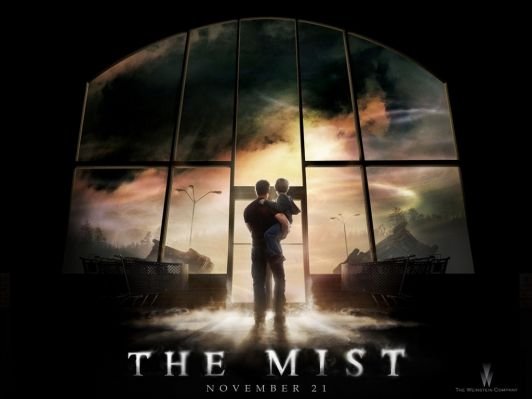
The Mist by Stephen King
My rating: 3 of 5 stars

And this brings me to the end of the 70s, in this chronological reading of Stephen King's body of work.

This was one average monster story. I'm not sure if I'd recommend it to any non-fan. Don't introduce anyone to King with this book, anyway.
Two points escape this generalisation: (1) the exploration of social dynamics in a time of crisis (which he does much more efficiently and with many more impli/complications in The Stand); and (2) the meditations of the protagonist who reflect King's agonies whether they make serious art or they're putting food on their family's plates, as hard working Americans have to.
[Harold Bloom would slap our hero (and King) to get himself together and stop entertaining foolish thoughts.]
In any case, the reader justifies the protagonist, as they justify King's storytelling, because apart from his repetitiveness and his not-that-sharpened-yet tools of his craft ("unreality" keeps "washing over" our protagonists since Salem's Lot), he still has one entertaining, honest (enough) story to say, one that you don't regret spending a few hours in the subway reading...

...even though if the whole thing would have been far more entertaining as the world's most hilariously unbelievable excuse to the missus if she ever confronted you with suspicions of your adultery with an out-of-towner lady. "Monsters! Giant bugs! Of course!"


View all my reviews
Creatures of a Day: And Other Tales of Psychotherapy by Irvin D. Yalom
My rating: 4 of 5 stars

Yalom's insight of the human psyche, along with the embrace of his own issues and his curiosity for the healing factor, delivers a read that becomes an authentic, true, therapeutic experience in its own right. This book highlights the importance of existential issues for the journey that therapy and self discovery is. It makes the reader feel less lonely in the process of this journey and becomes a virtual group-therapy experience that reaches out to all those who are looking for answers and keep asking questions.

View all my reviews
The Dead Zone by Stephen King
My rating: 5 of 5 stars

I've been in this chronological Stephen King reading a few months now, mostly because I put aside The Stand for a good few months.
King delivers a great novel, even though he is guilty of many of the sins he later condemns in his excellent "On Writing: a manual of the craft".
Up to the "Dead Zone", I find "The Long Walk", under Bachman's pen name, the most intense, timeless and thought-provoking piece of writing.
Dead Zone's an interesting read, as it illustrates King's evolution as an author, but it's also satisfying and entertaining, like watching a decent film with friends at home on DVD. Johnny, the tragic protagonist, is not effectively portrayed as ambivalent as the author probably intended, but stays with the reader long after the epilogue in the form of letters and hearing transcripts.

View all my reviews